April 01 2024
By: Shawn M. Galloway
In today's corporations, safety professionals play a crucial role in ensuring employees' well-being and the organization's success. To be viewed as strategic leaders within a corporation, safety professionals must implement specific strategies that align safety initiatives with business goals, quantify impact, communicate effectively, engage leadership, integrate risk management, leverage benchmarking and best practices, prioritize continuous improvement, invest in training and development, foster cross-functional collaboration, and proactively address safety challenges. By adopting these strategies, safety professionals can position themselves as strategic leaders who contribute significantly to the organization's success. Let's explore these strategies.
Align with Business Goals: Aligning safety initiatives with overall business objectives is essential for demonstrating a strategic contribution. By understanding the organization's goals and integrating safety measures that support those objectives, 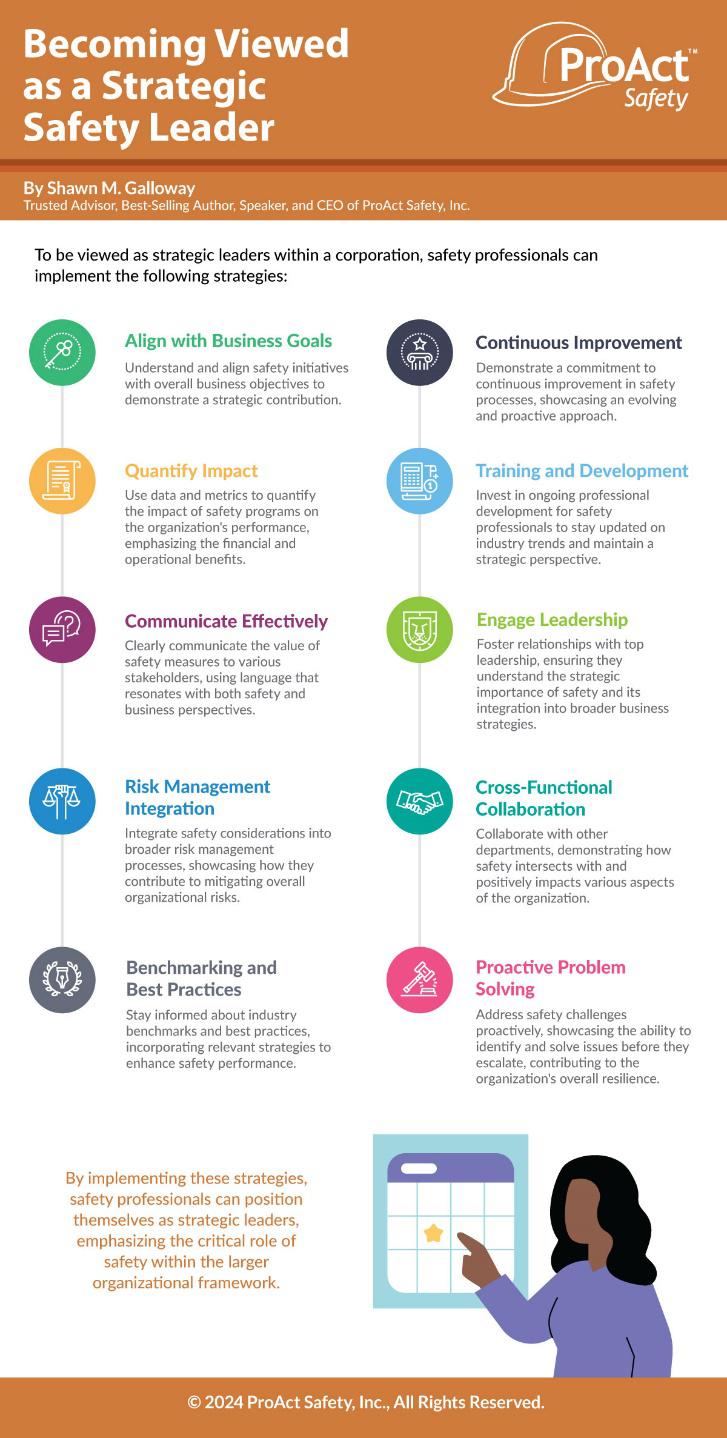 safety professionals showcase the value of safety in driving business success.
Quantify Impact: Utilizing data and metrics to quantify the impact of safety programs on the organization's performance is crucial. Emphasizing the financial and operational benefits of safety initiatives helps stakeholders understand the tangible value that safety brings to the organization.
Communicate Effectively: Clear and effective communication is key to conveying the importance of safety measures to various stakeholders. Using language that resonates with both safety and business perspectives helps bridge the gap and ensures that the strategic value of safety is well understood across the organization.
Risk Management Integration: Integrating safety considerations into broader risk management processes showcases how safety contributes to mitigating overall organizational risks. Safety professionals underscore their strategic impact on the organization by demonstrating the interconnectedness of safety and risk management.
Benchmarking and Best Practices: Staying informed about industry benchmarks and best practices allows safety professionals to enhance safety performance by incorporating relevant strategies. Leveraging external insights and proven methodologies helps drive continuous improvement in safety processes.
Continuous Improvement: Committing to continuous improvement in safety processes demonstrates an evolving and proactive approach. By constantly seeking ways to enhance safety measures and address emerging challenges, safety professionals showcase their dedication to advancing safety practices within the organization.
Training and Development: Investing in ongoing professional development for safety professionals is crucial for staying updated on industry trends and maintaining a strategic perspective. Continuous learning and skill enhancement enable safety professionals to adapt to evolving safety requirements and drive innovation in safety initiatives.
Engage Leadership: Building relationships with top leadership and ensuring they understand the strategic importance of safety is vital. By integrating safety into broader business strategies and highlighting its role in achieving organizational goals, safety professionals can gain the support and endorsement of key decision-makers.
Cross-Functional Collaboration: Collaborating with other departments and showcasing how safety intersects with various aspects of the organization is key to demonstrating the holistic impact of safety initiatives. By fostering cross-functional partnerships, safety professionals highlight the interconnected nature of safety and its positive influence on organizational performance.
Proactive Problem Solving: Strategic safety leadership focuses on proactively addressing safety challenges and demonstrating the ability to identify and solve issues before they escalate. Safety professionals who take this approach contribute to the organization's overall resilience and risk mitigation efforts.
Safety professionals can position themselves as strategic leaders within a corporation by implementing key strategies that align safety with business goals, quantify the impact, communicate effectively, engage leadership, integrate risk management, leverage benchmarking and best practices, prioritize continuous improvement, invest in training and development, foster cross-functional collaboration, and proactively address safety challenges. Safety professionals can elevate their status and significantly impact the organization's success by emphasizing the critical role of safety within the larger organizational framework and showcasing the strategic value of safety initiatives.
"Nothing stops an organization faster than people who believe that the way you worked yesterday is the best way to work tomorrow." — Jon Madonna
"The very essence of leadership is that you have to have a vision. It's got to be a vision you articulate clearly and forcefully on every occasion. You can't blow an uncertain trumpet." — Reverend Theodore Hesburgh
"The key to becoming relevant in the marketplace is to add value. The more value you can add the more relevant you will become." — Germany KentP

Shawn Galloway, CEO of ProAct Safety, is an expert in safety excellence. With almost thirty years of experience, he is a highly sought-after advisor, keynote speaker, and expert witness. Shawn has become a trusted partner to leading organizations across various industries worldwide. He ranks in the top 1% of the most prolific writers in his field, having authored over 500 articles and several bestselling books. He also launched the world's first safety podcast, Safety Culture Excellence©. As a recognized authority in safety, Shawn has received awards such as being named among the Top 50 People Who Most Influence EHS and a Top 10 Speaker, among others.
He is a regular guest on Bloomberg, Fox News, The Daily Mail, Dubai One, U.S. News & World Report, Sirius Business Radio, Wharton Business Daily, and leading safety magazines and podcasts. Shawn also serves as a member of the Harvard Business Review Advisory Council, Forbes Business Council, and Fast Company Executive Board, enabling his influence to shape safety thinking and strategy at the executive level.
