Incident Prevention - December 2025
By: Shawn M. Galloway
Printable Version
As we stand on the brink of a new era in the utility sector, it is clear that the future holds transformative potential driven by relentless technological progress. We are not just seeing small changes, but a complete overhaul fueled by innovation and safety. The horizon is filled with innovations aimed at redefining safety protocols and operational efficiency. Predicted advancements, ranging from smart grids and augmented reality training to IoT-based monitoring systems and robotics, point to a future where advanced technologies will become essential to everyday utility operations.
These are not just glimpses of what might be possible; they form the foundation upon which future safety standards will be built. As these technologies become widespread, they will not only enhance the safety of workers and consumers but also lay the groundwork for a more sustainable and resilient public utility framework. This article examines the upcoming technological renaissance that will ensure safety remains the top priority and a core value in the sectors powering our daily lives. Here are ten predictions, in my professional opinion, of what will become commonplace over the next few years, including when they are likely to do so.
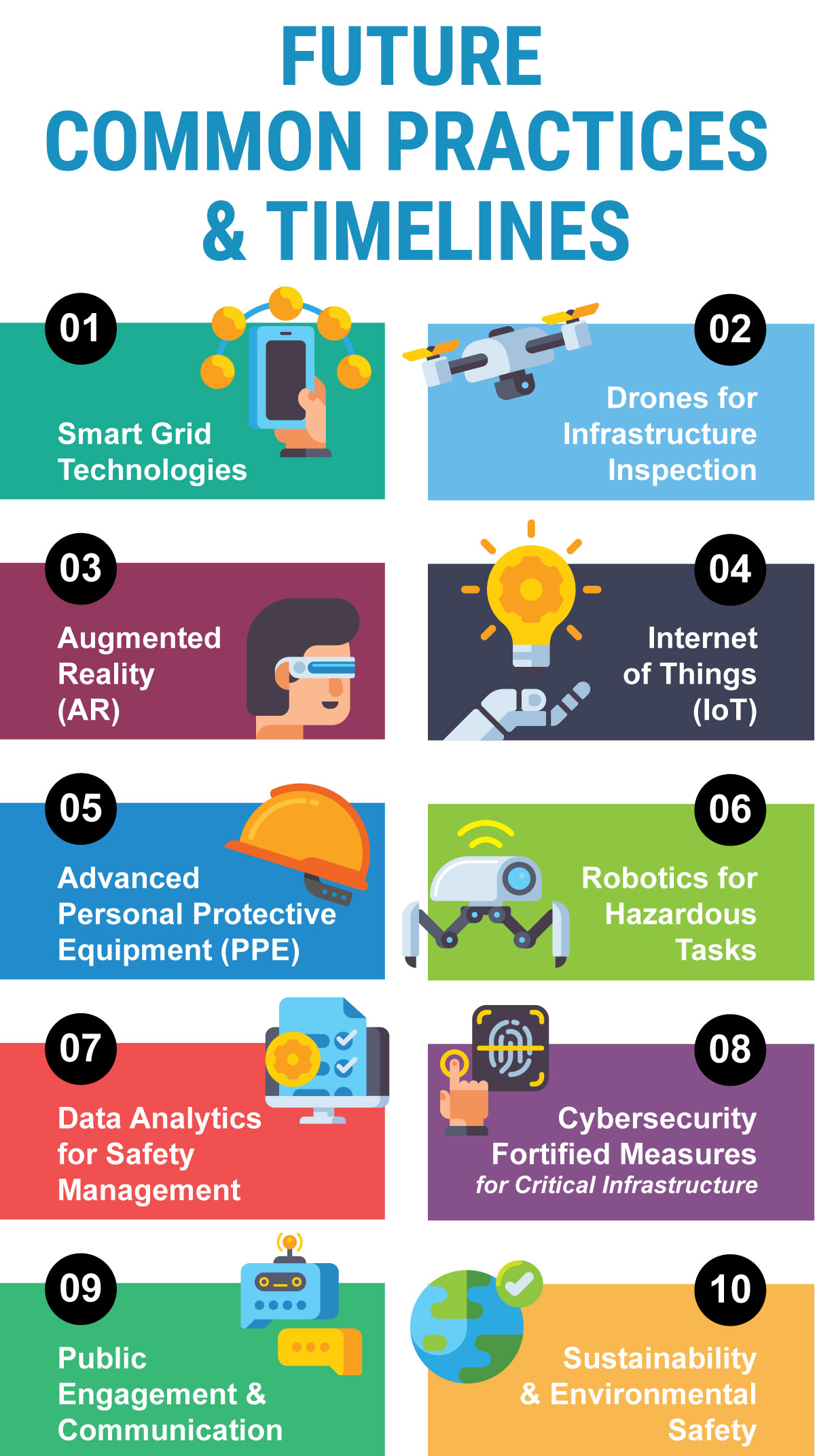
Future Common Practices and Timelines
Smart Grid Technologies: Leading the way. These digital monitors, equipped with sensors and real-time analytics, transform how we track and control electrical grids. Utilities like PG&E are already deploying systems that quickly detect faults and hazards, preventing accidents and enhancing safety for workers and consumers. This proactive strategy ensures reliability and improves operational efficiency. When? Many utilities have already started integrating smart grid systems. Over the next 5 to 10 years, wider adoption is expected as infrastructure upgrades progress and costs fall.
Drones for Infrastructure Inspection: Now the unsung heroes, quietly surveying our extensive networks. Equipped with precision cameras and thermal imaging, they reach places humans can't, reducing risk and improving safety. PSEG demonstrates this with drones that safely navigate power lines and substations, providing fast and accurate assessments without endangering lives. When? Drone technology is rapidly being adopted and could become standard within the next 5 years, especially for larger utilities that have the resources to invest in and operate these systems.
Augmented Reality (AR): This approach to training changes how utility workers prepare for field challenges. Southern Company leads with AR headsets that simulate real-world scenarios, providing immersive training that enhances hazard recognition and emergency response, key to reducing workplace incidents. When? AR is increasingly integrated into training programs and may become a standard tool for utility workers within the next 5 to 7 years as hardware becomes more affordable and software more advanced.
Internet of Things (IoT): This forms the basis of safety measures. Using vigilant smart sensors, anomalies are detected immediately. For example, DTE Energy in Michigan deploys IoT sensors that monitor underground cables for early fault signals. This allows the utility to perform targeted maintenance or repairs before a fault causes outages or safety hazards. This proactive approach greatly reduces downtime, prevents accidents, and improves safety for field crews working in potentially dangerous underground environments. When? IoT integration in utilities is already progressing and is expected to become widespread within the next 5 to 10 years as the technology becomes more accessible and companies prioritize efficiency and safety.
Advanced Personal Protective Equipment (PPE): Advancements in PPE combine technology with traditional safety gear to enhance protection. Innovations like Honeywell's smart helmets provide real- time environmental data, making proactive safety a practical reality, and 3M's electronic hearing protectors help communicate with others in noisy environments. When? Smart PPE could become standard in high-risk settings within the next five years, as companies, driven by altruism or public pressure, increasingly prioritize worker safety, and the costs of technology decrease.
Robotics for Hazardous Tasks: Emerges as an essential partner in high-risk tasks. These machines, such as Boston Dynamics' Spot robot, carry out complex inspections and repairs in hazardous environments, ensuring human safety is protected even in the most extreme conditions. When? Although robotics is being used now, full adoption across all utilities might take 10 to 15 years, depending on technological advancements and economic factors.
Data Analytics for Safety Management: Transforms historical data into a guide for future safety. By utilizing advanced analytics, companies like Duke Energy analyze past incidents to identify patterns and prevent future accidents, thereby fostering a culture of continuous safety improvement. In 2018, ProAct Safety conducted an industry-wide benchmarking project on this for public utilities. Even then, it was found that advanced data analytics were already in use, and their application is expected to become more sophisticated over the next 3 to 5 years as utilities leverage more data-driven insights to enhance safety.
Fortified Cybersecurity Measures for Critical Infrastructure: The demand for cybersecurity rises due to the evolving digital landscape. As systems become more interconnected, protecting against cyber threats is essential. The U.S. Department of Energy's initiatives, such as the Cybersecurity Capability Maturity Model (C2M2), provide key frameworks to defend against digital threats, ensuring that operations are not compromised by cyber espionage and political terrorism. When? As digital integration increases, improved cybersecurity will become vital and likely widespread within the next 5 years, safeguarding infrastructure against emerging threats.
Public Engagement and Communication: These channels improve transparency and build trust. Through platforms like FPL's mobile apps, communities receive real-time alerts during crises, strengthening the connection between public utilities and the public through informed communication. When? Real-time communication via digital platforms is becoming standard and is likely to be fully integrated within the next 5-7 years as part of customer service enhancements.
Sustainability and Environmental Safety: This is vital for ensuring long-term resilience and community well-being. A leader in this field is Montrose Environmental Group, which incorporates comprehensive environmental safety protocols into its operations by using advanced monitoring systems that track pollutants and emissions in real time. Their use of innovative technologies, such as IoT sensors and data analytics, allows for precise identification and mitigation of environmental hazards before they escalate. Utility companies will look to Montrose's practices by adopting sustainable technologies like renewable energy sources, waste reduction methods, and advanced environmental monitoring tools. When? Comprehensive environmental safety tools and services like IoT sensors, real-time monitoring, and advanced data analytics are expected to become standard across most US utility companies within the next 10 years.
Timeline Summary
Overall, although early movers are already adopting some of these technologies, widespread implementation across all utilities will take time due to varying resource capabilities and infrastructure readiness. However, the next decade will see broad adoption of advanced safety and sustainability technologies across US utility companies, benefiting employees, contractors, and the community.
Shared Responsibility
Essentially, the public utility sector is not only adapting but also actively embracing a future where safety seamlessly integrates with innovation. Smart grids, AR, IoT, and robotic interventions are more than just technological advancements; they represent our collective commitment to a safer, more efficient, and sustainable future. As these technologies advance, our ability to protect workers and communities will also improve, showing that safety is not merely an operational priority but a shared responsibility. The stakes are high, but the potential for progress is enormous.
These predictions are based on my expert insights and current trends in the utility industry. While the adoption pace may vary among organizations and regions, the main trend is clear: technology will become increasingly vital to safety and sustainability efforts. Now is the right time for industry leaders, policymakers, and all stakeholders to actively adopt these innovations. Investing in modern safety solutions today not only prepares your organization for the future but also shows your commitment to protecting workers, communities, and the environment. Let's collaborate to speed up the integration of these groundbreaking technologies, ensuring a safer, more resilient, and sustainable power grid for future generations. The future of utility safety excellence is within our reach; it's up to us to turn it into reality.

Shawn Galloway, CEO of ProAct Safety, is an expert in safety excellence. With almost thirty years of experience, he is a highly sought-after advisor, keynote speaker, and expert witness. Shawn has become a trusted partner to leading organizations across various industries worldwide. He ranks in the top 1% of the most prolific writers in his field, having authored over 500 articles and several bestselling books. He also launched the world's first safety podcast, Safety Culture Excellence©. As a recognized authority in safety, Shawn has received awards such as being named among the Top 50 People Who Most Influence EHS and a Top 10 Speaker, among others.
He is a regular guest on Bloomberg, Fox News, The Daily Mail, Dubai One, U.S. News & World Report, Sirius Business Radio, Wharton Business Daily, and leading safety magazines and podcasts. Shawn also serves as a member of the Harvard Business Review Advisory Council, Forbes Business Council, and Fast Company Executive Board, enabling his influence to shape safety thinking and strategy at the executive level.
