ISHN - September 2026
By: Shawn M. Galloway
Printable Version
The engagement most organizations measure is the engagement they are quietly destroying, and the place where it is won or lost is rarely the place where leaders look.
Walk into the average monthly safety review, and the engagement story looks healthy. Survey scores are up, turnover is down, absenteeism is flat, incident rates are low, the recognition program is funded, the values posters have been refreshed, and one more communication channel has been added. On paper, the workforce is engaged. The dashboard reports those numbers accurately. What it misrepresents is their meaning.
Here is the claim that tends to unsettle a room. Most people do not arrive at work disengaged. They arrive motivated, and then, across a single shift, the organization gets to work beating them up, figuratively at least. Conflicting directives from two supervisors. A rule that consumes time without reducing risk. A permit process that takes longer than the task it authorizes. A leader who checks everything and trusts nobody. A commitment quietly broken. By the end of the day, the motivation people carried through the door has been spent, and very little of it goes into the work. When engagement lags, the instinct is to add something: another program, another incentive, another campaign. The more useful question is what should we stop doing?
Some of the damage is being done in the name of safety
One version of this deserves its own name, and I have come to call it the Iatrogenic Precaution Effect. The term comes from medicine, where iatrogenic harm is harm caused by treatment rather than by the disease. Safety interventions can harm the people they were designed to protect, and the harm is rarely physical. It shows up in the credibility of the safety function and in the willingness of a capable person to raise the next concern. A control that demands more attention than the risk it addresses is not free; it is paid for out of goodwill you will need later, usually on the day someone has to decide whether speaking up is worth the trouble.
This is uncomfortable territory for our profession because it means some of the reason engagement leaks out of the jobsite, is our doing.. It is also the most accessible improvement available to most safety functions, since removing a requirement needs neither a budget cycle nor an executive sponsor.
No one can install discretionary effort
Engagement is the discretionary effort a person brings or withholds every day, by choice. It cannot be imposed from the top, nor can it be purchased with an incentive, at least not for long. What leaders can do is stop draining it, and that single reframe shifts where you look. Most organizations do not have an engagement shortage so much as an engagement leak, a steady loss of goodwill through a hundred small frustrations that no recognition program can refill faster than the system drains it.
The spectrum, and the neutral point in the middle
In my 2025 book, Shared Ownership: Engaging the Subcultures, I map this on a single line I call the Engagement Spectrum. At one end sits Disdain, which, in the language of the book, is the desire to burn this place down. At the other end sits Shared Ownership, the highest form of engagement, the state in which people take collective responsibility for one another, regardless of title, certain that, whatever the adversity, they will win as one team. Between those ends sit the positions most workforces occupy, with Apathy and Uninterested to the left of the middle, and Interested, Buy-In, Willing Participation, and Self-Ownership to the right.
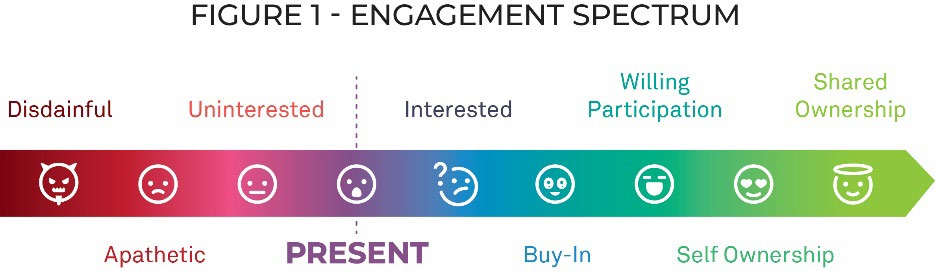
Figure 1. The Engagement Spectrum, from Shawn M. Galloway, Shared Ownership: Engaging the Subcultures (2025).
In the middle sits Present, and Present is not one of the positions. It is the neutral point, the zero, where a person is neither engaged nor disengaged. That distinction carries more weight than it first appears, because a position on the spectrum leaves evidence, whereas neutral does not.
The most dangerous state is the one in the middle
The Present employee is on autopilot, showing up, doing the job, collecting the paycheck, and spending every ounce of discretionary effort elsewhere, on a side business, a hobby, a second job, or family. Present workers file no complaint, trigger no turnover, pass the audits, and hit the quotas, so every metric reads as engaged, even though no discretionary effort ever enters the building. You are paying full price for capacity you are not receiving, and your reporting cannot see the gap. Disdain announces itself, and so does Apathy, eventually. Neutral will accumulate for years without moving a single number.
You do not have one culture. You have at least as many as you have supervisors.
Executives speak of their culture as though it were a single thing. It is not. For every supervisor you have, you also have a subculture. That means counting your frontline supervisors counts the potential number of subcultures, and an enterprise-wide engagement initiative aimed at the average culture is aimed at a place that exists nowhere on your floor. The average is a statistical ghost. Engagement is won or lost within each supervisor’s span of control.
This is why the lever is rarely where it gets reached for. The people who determine whether an organization receives discretionary effort are frontline supervisors, not Leadership (with a capital L), not the initiative, not the speaker, not the incentive, and not the threat. They make or break engagement day by day, decision by decision. Senior leaders set the conditions; supervisors set the temperature. The implication is unglamorous and exact. Give supervisors the training, the tools, and the time to build engagement rather than handing them a slogan and a deadline. Then lead them precisely the way you are asking them to lead their people, because they will copy what you do long before they do what you say.
Rules produce compliance. Values produce ownership.
When values are genuinely shared, very little supervision is required because people are working toward their own principles. They may break a rule; they will not break their values. Compliance produces a Present employee. Values produce Ownership, and those two workforces do not perform the same under pressure. It is worth saying plainly that Shared Ownership from one hundred percent of your people is neither realistic nor necessary, and chasing it will only exhaust a leadership team. What carries a culture through hard conditions is a strong, resilient majority who have moved past the neutral point of their own accord.
Where the spectrum stops, and what comes next
The spectrum shows where people stand. It does not indicate whether your organization can move them or hold them once they have moved. That is a separate property, and in a forthcoming book I treat it as one of seven capacities that determine whether excellence outlasts the leader who launched it. Engagement Capacity is the organizational ability to earn discretionary effort and sustain it, and it is the capacity most often confused with the evidence (or proxy) of itself.
Consider what usually stands in for that evidence. Attendance at the safety meeting, observation card counts, committee rosters, completed training records, and closed-out suggestion submissions. Every one of those records is something people were required to do, so when they become proof of engagement, an organization has measured its own requirements and learned nothing about willingness. Participation that stops the moment it is no longer mandatory was never engagement in the first place. It was attendance. The measures worth building are the ones that record a choice: a concern raised where no form demanded it, a job stopped by someone who had no obligation to stop it, a hazard fixed by the crew before anyone above them knew it existed.
Why this belongs on the margin page, not the morale page
At enterprise scale, mistaking Present for engaged carries a cost that has little to do with how people feel about their jobs. Discretionary effort is the reserve an organization draws on when conditions turn hard, when something breaks, or when the plan finally meets reality. A workforce sitting at neutral has no reserve to give. It looks stable right up to the moment it has to adapt, and then it cannot. That is a fragility that will never appear on a survey and will only be discovered during an event. That is the version of this argument to carry upstairs, in the language the room already uses, when the engagement budget comes up for approval.
Questions to ask before the next initiative is funded
What are we doing right now that beats motivation out of capable people, and which of those things did we introduce ourselves, in the name of safety? How much of our workforce is sitting at neutral, a state our metrics would never reveal? How many subcultures do we actually have, and which of our supervisors are quietly building the ones we would not want to scale? Which of our engagement measures capture what people chose, and which capture what we required? And are we trying to add engagement to a system that is busy subtracting it?
An organization that does not know how much of its workforce is sitting at neutral does not really know what it is capable of. So here is the question I would leave you with, and I would ask you to reflect on it rather than answer it quickly. If half your people showed up tomorrow exactly Present and not one step further, every number on your dashboard would still look fine. So, what would show you the truth, and how long would it take you to notice?
Sidebar: Three checks you can run this month
First, audit your own additions. List every safety requirement introduced in the last two years, then ask of each one what risk it reduced and how much time it consumed. Retire the ones that fail both tests and announce the retirements as clearly as you announced the requirements.
Second, separate your chosen measures from your required ones. Put every engagement indicator you report into two columns, one for things people had to do and one for things they chose to do. If the second column is thin, you do not yet have a good read on engagement.
Third, look at variation instead of averages. Break down your last perception survey by supervisor rather than by site or department and look for the spread rather than the mean. The subcultures you cannot see are the ones setting your ceiling.
I explore the Engagement Spectrum, and how leaders can move people along it, in greater depth in a recent conversation on the ISHN All Things Safety podcast: Beyond Check-the-Box Safety.
Figure from Shawn M. Galloway, Shared Ownership: Engaging the Subcultures (2025).

Shawn Galloway, CEO of ProAct Safety, is an expert in safety excellence. With almost thirty years of experience, he is a highly sought-after advisor, keynote speaker, and expert witness. Shawn has become a trusted partner to leading organizations across various industries worldwide. He ranks in the top 1% of the most prolific writers in his field, having authored over 500 articles and several bestselling books. He also launched the world's first safety podcast, Safety Culture Excellence©. As a recognized authority in safety, Shawn has received awards such as being named among the Top 50 People Who Most Influence EHS and a Top 10 Speaker, among others.
He is a regular guest on Bloomberg, Fox News, The Daily Mail, Dubai One, U.S. News & World Report, Sirius Business Radio, Wharton Business Daily, and leading safety magazines and podcasts. Shawn also serves as a member of the Harvard Business Review Advisory Council, Forbes Business Council, and Fast Company Executive Board, enabling his influence to shape safety thinking and strategy at the executive level.
