Professional Safety - September 2026
By: Shawn M. Galloway
Printable Version
In environments where discipline meets daring, and precision blends with perseverance, the United States Navy SEALs stand as paragons of excellence. Safety professionals can learn essential lessons from the SEALs, who exemplify discipline, teamwork, and resilience—key elements in fostering a culture of excellence. SEALs undergo rigorous training to anticipate and manage risks in demanding situations, and similarly, safety experts can implement proactive measures to identify hazards before they escalate into serious issues. SEALs emphasize the importance of clear communication and trust within their teams, creating an environment where employees feel secure enough to report concerns without fear of repercussions. By adopting a mindset of continuous improvement and maintaining an unwavering commitment to safety, much like the SEALs' pursuit of excellence, organizations can cultivate a culture with the capacity to make safety a core value, not just a policy or priority.
The influence of human and organizational performance is pivotal in determining safety success. This article delves into the essential elements of human and organizational performance using insights from the Navy SEALs to enhance safety culture and performance. By analyzing the SEALs' fundamental principles, we can uncover valuable strategies to advance safety excellence that are not industry specific.
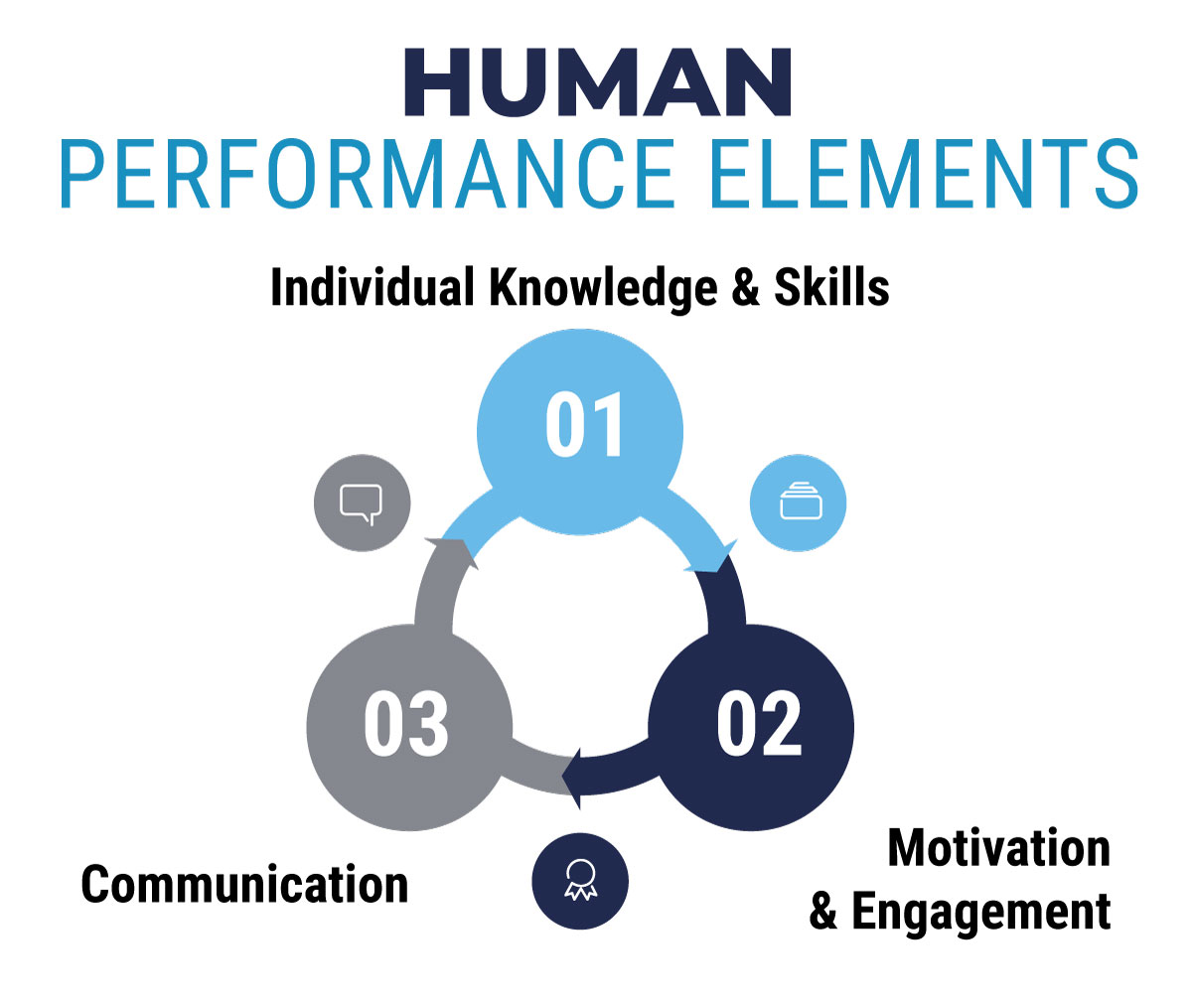
Human Performance Elements
- Individual Knowledge and Skills
- Motivation and Engagement
- Communication
The basis of human performance is rooted in the knowledge and skills of individual employees. Competence in job-related tasks is crucial for reducing errors and boosting efficiency. According to Salas et al. (2012), training and education are vital for improving employees' competencies. Organizations that invest in ongoing learning programs foster a culture of safety, where employees possess the necessary skills to identify hazards and respond effectively.
The U.S. Department of Energy (DOE) emphasizes the importance of training but to not rely on it alone as a preventative tactic in its Human Performance Improvement Guidebook (U.S. DOE, 2009, pg 55), which states that "Not all hazards, dangers, and possible scenarios can be anticipated in order to develop appropriate procedures. Even training is unable to anticipate all possible situations that can be encountered." The Navy SEALs exemplify this principle through their rigorous and comprehensive training programs, which prepare members for a wide range of scenarios because they realize that no plan of action survives contact with the enemy, because the enemy hasn't voted yet. As former SEAL and leadership consultant Jocko Willink states, "Discipline equals freedom" (Willink, 2017). This quote captures the essence of their training philosophy: through discipline in training, SEALs gain the freedom to make quick, effective decisions in high-pressure and even unanticipated situations.
Employee motivation and engagement greatly influence safety performance. When workers are motivated, they are more likely to follow safety protocols and actively take part in safety initiatives. Based on Gallup's 2016 study on engagement, found, "…companies with engagement scores in the top 25% of Gallup's employee engagement database have 70% fewer safety incidents than those located in the bottom 25%" (Ross, 2016).
The Navy SEALs demonstrate a high level of intrinsic motivation, driven by a strong sense of purpose and camaraderie. This motivation is developed through shared goals and mutual accountability among team members. Former SEAL and author David Goggins highlights the importance of internal motivation and perseverance, stating, "Always be ready to adjust, recalibrate, and stay after it to become better, somehow" (Goggins, 2018). This outlook encourages individuals to go beyond their limits and face challenges, which directly helps foster a culture where employees are motivated to take an active and proactive part.
Effective communication is crucial for ensuring that safety information is shared and understood throughout the organization. According to Reason (1997), clear communication decreases misunderstandings that can lead to accidents. The DOE guidebook highlights the importance of clear communication in fostering a culture of accountability and safety, noting that "Finding and eliminating latent weaknesses improve dramatically when worker feedback and communication are encouraged" (U.S. DOE, 2009, pg 99).
The SEALs emphasize communication as the "lifeblood of operations" (Fussell, 2017). Their success depends on clear, concise language and non-verbal signals that aid coordination under pressure. As former SEAL Chris Fussell says, "As a leader, you must consistently drive effective communication. Meetings must be deliberate and intentional — your organizational rhythm should value purpose over habit and effectiveness over efficiency." Organizations should establish open communication channels that encourage employees to report safety concerns without fear of retaliation. Regular safety meetings, bulletins, and digital platforms can support this exchange of information, much like how SEAL teams maintain constant communication during missions.
Organizational Performance Elements
- Safety Culture
- Leadership Commitment
- Systems Thinking
The U.S. Department of Transportation defines safety culture as "the shared values, actions, and behaviors that demonstrate a commitment to safety over competing goals and demands. However, this now common description is limited as it tends to describe characteristics and does not address capabilities. "The most basic capability of a safety culture is the ability to improve. That is the real challenge; not what managers or consultants can make of a safety culture, but what a safety culture can make of itself" (Mathis, Galloway, 2013, pg xiii). A strong safety culture promotes a proactive safety approach, where employees prioritize safety over productivity and feel safe discussing concerns or ideas. It is important to remember that safety culture is just one aspect of occupational culture. 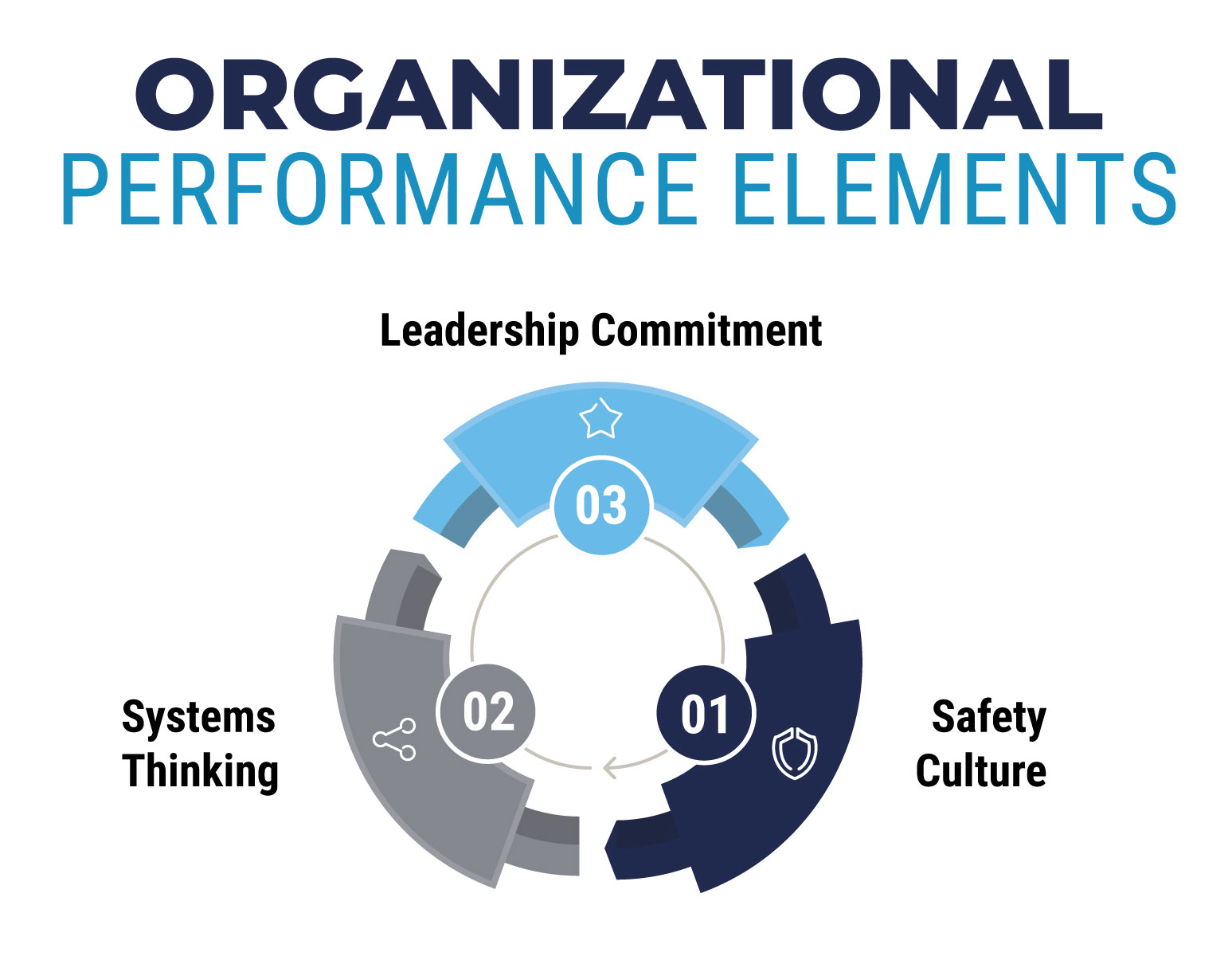 Culture is the common beliefs that influence and govern common behaviors, and is more about the mindset behind why we do what we do than how we do things around here.
The Navy SEALs embody a culture where safety is ingrained in every aspect of their operations. Safety is a core value, guiding systematic behaviors and decision-making that prioritize well-being. This is embodied in the SEAL common mantra, "Slow is Smooth, Smooth is Fast". When our mindset is focused on safety, we can achieve anything.
Leadership is essential in shaping organizational performance and safety outcomes. Leaders who genuinely commit to safety set the tone for the entire organization and, in turn, create additional leaders through influence rather than control. According to Zohar (2002), transformational leadership that emphasizes safety can improve safety performance.
In the SEALs, leadership is demonstrated in every mission and is viewed as a responsibility to yourself and your team. It's reflected in how missions are carried out, not just through a figurehead issuing commands. The SEAL ethos states, "We expect to lead and be led. In the absence of orders, I will take charge, lead my team, and accomplish the mission," emphasizes this principle (SEAL Ethos, n.d.).
Adopting a systems thinking approach helps organizations understand the connections between different elements of performance and safety. This approach highlights that human and organizational factors are linked and that changes in one area can affect others.
The DOE guidebook also emphasizes the importance of systems thinking, and understanding human factors. "Human factors is the name of an engineering profession that focuses on how people interact with tasks, machines or computers, and the environment, with the consideration that humans have limitations and capabilities. Often, human factors will study the human within the system to ensure that we understand the limitations of the human within the current structure, product, or process" (U.S. DOE, 2009, pg 146). Galloway (2021) underscores the need for a "systemic approach" to safety, integrating safety performance into overall business processes to boost organizational resilience. The SEALs apply systems thinking to adapt their strategies flexibly, ensuring mission success in complex environments. Former SEAL and author Brandon Webb writes about the importance of systems thinking, training, and understanding the bigger picture in the context of Navy SEAL training and sniper work in his book, The Red Circle: My Life in the Navy SEAL Sniper Corps and How I Trained America's Deadliest Marksmen (Webb, 2013).
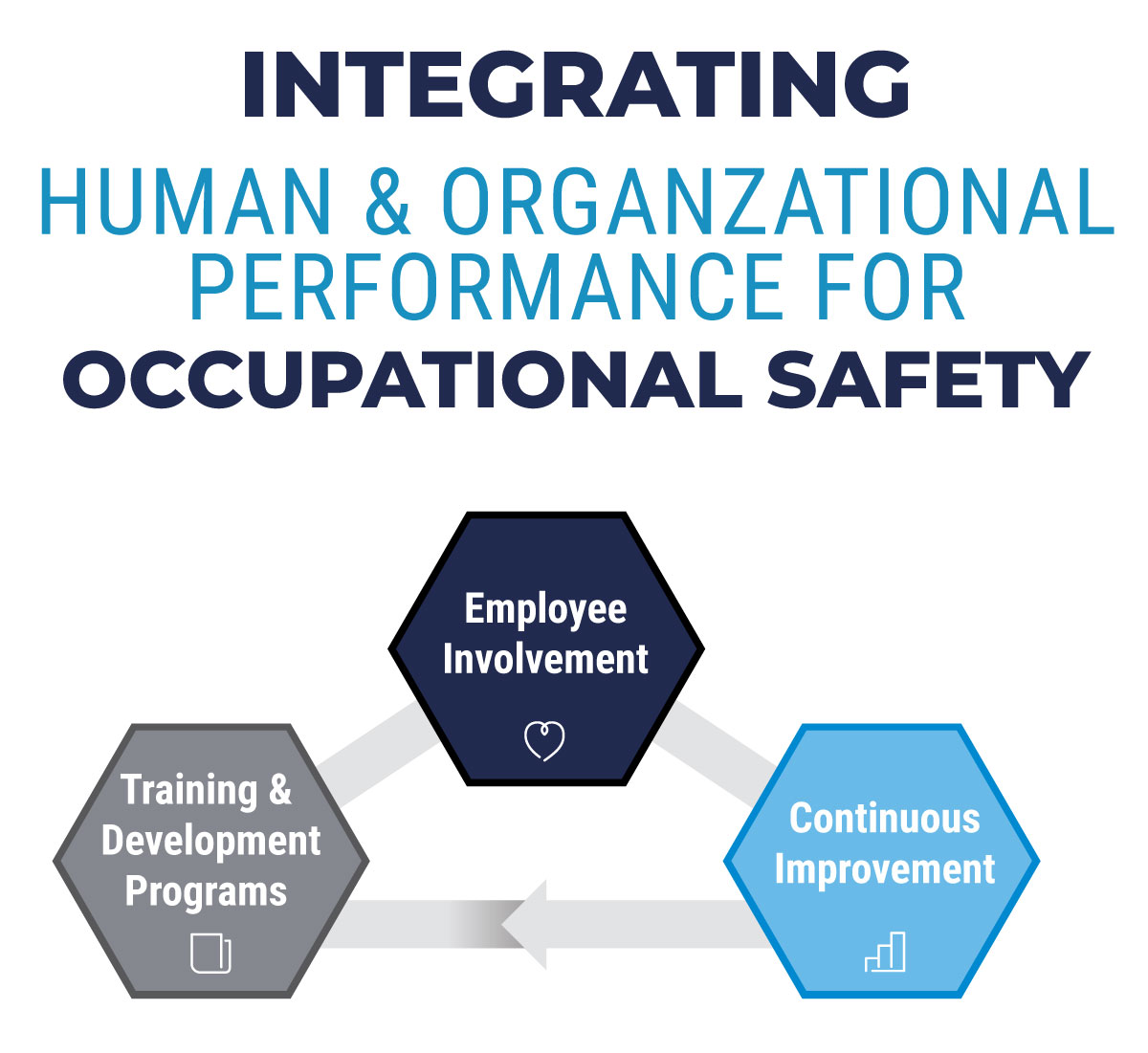
Integrating Human and Organizational Performance for Occupational Safety
- Training and Development Programs
- Employee Involvement
- Continuous Improvement
Integrating human performance elements, such as knowledge and skills, into organizational training programs can enhance workplace safety. For instance, scenario-based training that simulates real-life safety challenges enables employees to practice their skills in a controlled environment (Salas et al., 2012). The DOE supports this approach by advocating for dynamic training programs that adapt to changing workplace conditions and challenges.
By bridging the gap between knowledge and application, organizations can enhance safety performance. The SEALs exemplify this through their rigorous training, often summarized by the phrase "Embrace the suck," (Gleeson, 2020) which encourages trainees to "lean into the suffering and get comfortable being very uncomfortable" during intense sessions like Hell Week. Training should go beyond simply teaching task completion; it must include comprehensive programs that combine routine safety drills with simulations of unexpected scenarios. This approach ensures employees are equipped to respond confidently and effectively during emergencies. However, it's important not to draw the line at unnecessary suffering—leave that to special operations.
Encouraging employee participation in safety initiatives promotes a sense of ownership and responsibility. For example, involving employees in creating safety policies and procedures can result in more relevant and effective safety measures. The SEALs demonstrate this principle by encouraging all team members to contribute to mission planning, emphasizing that every voice matters in the pursuit of safety.
Organizations should implement a continuous improvement approach to safety by regularly assessing and updating safety procedures. This may include performing safety audits, reviewing incident reports, and gathering employee feedback. By fostering a culture of learning and adaptation, organizations can proactively address safety issues and enhance overall performance.The SEALs' commitment to the military standard of After-Action Reviews (AARs) demonstrates this principle, as they analyze missions to learn from successes and failures, fostering a culture of ongoing learning. As former SEAL and author David Goggins states, "In every failure there is something to be gained, even if it's only practice for the next test you'll have to take. Because that next test is coming. That's a guarantee" (Goggins, 2018).
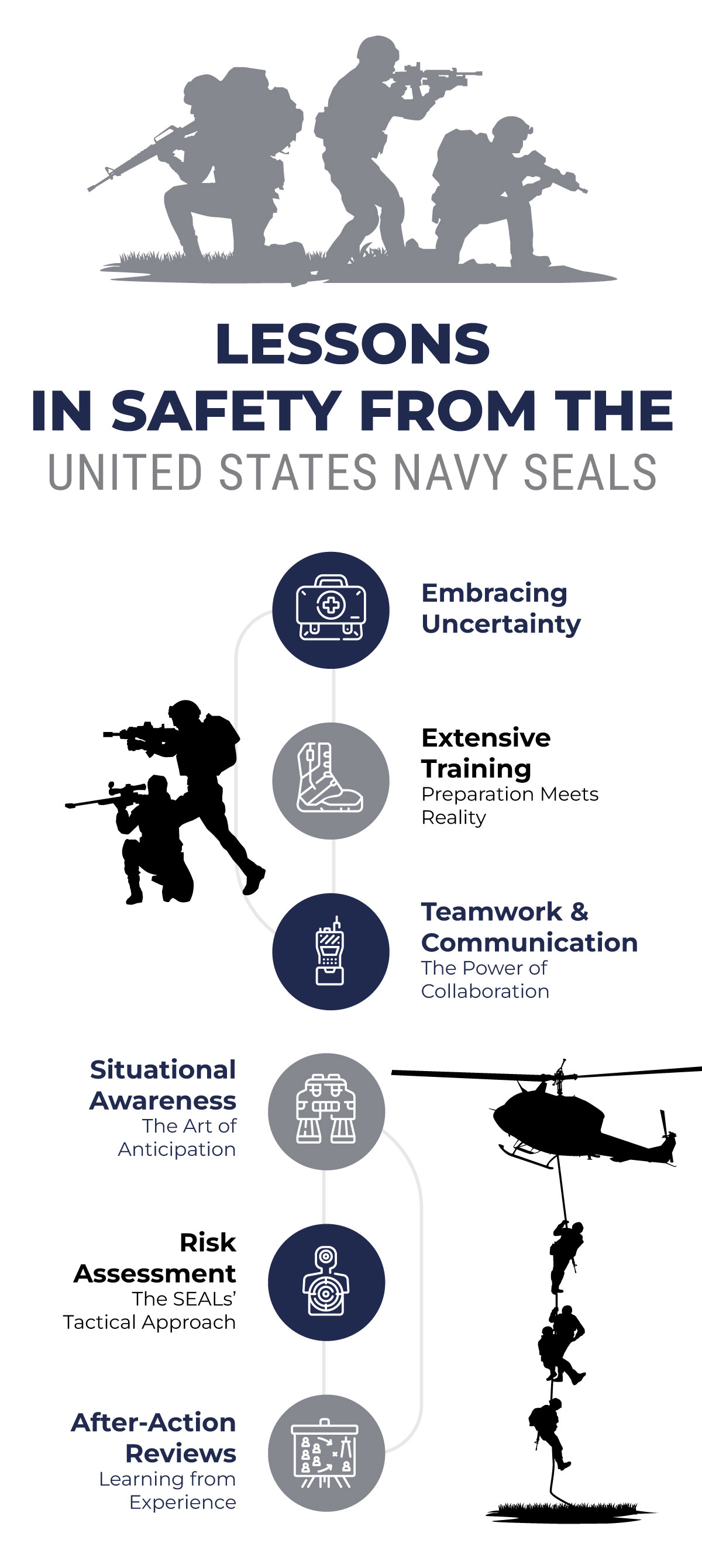
Lessons in Safety from the United States Navy SEALs
- Embracing Uncertainty
- Extensive Training: Preparation Meets Reality
- Teamwork and Communication: The Power of Collaboration
- Situational Awareness: The Art of Anticipation
- Risk Assessment: The SEALs' Tactical Approach
- After-Action Reviews: Learning from Experience
At the heart of the SEALs' operational philosophy is a steadfast acceptance of uncertainty. They recognize that even with careful planning, each mission can face unexpected challenges. This mindset is also vital for safety professionals. By accepting uncertainty, safety experts can develop a more flexible and responsive approach to managing risks.
The SEALs go through a tough training program that pushes their physical and mental limits. This preparation isn't just about building skills; it's about mimicking real-world situations that might happen during a mission. As former SEAL and author Mark Owen stresses, "The best way to make your team succeed is to make them fail in training" (Owen, 2015). This level of preparation can be reflected in the safety field. Organizations can hold regular training sessions that simulate emergency scenarios, such as fire drills, evacuation plans, or even cyber-attack response drills.
SEAL missions are carried out by close-knit teams where each member knows their role and trusts their teammates completely. This camaraderie is built through intense training and a shared dedication to the mission's success. Communication is crucial; SEALs use clear, direct language and non-verbal signals to stay coordinated under pressure. Safety professionals should foster a collaborative environment where employees feel at ease sharing safety concerns and set up regular communication channels to keep everyone updated on safety protocols.
A hallmark of SEAL operations is their sharp situational awareness. They are trained to observe their environment, evaluate potential threats, and anticipate changes. This skill enables them to adapt their strategies on the fly, ensuring mission success. Safety professionals should develop a similar awareness by regularly performing site assessments, utilizing checklists, and encouraging employees to report any anomalies they notice.
 Before each mission, SEALs conduct detailed risk assessments by identifying potential threats and creating multiple contingencies and backup plans. Safety professionals can follow a similar process by conducting systematic risk evaluations in their workplaces and better understand work as done and the alignment or misalignment from work as planned. This involves spotting potential hazards, assessing the chance and severity of each risk, and formulating strategies to reduce them.
One of the most important parts of the SEALs' operational strategy is their dedication to debriefing after each mission. These aforementioned AARs help teams evaluate what went well, what didn't, and what could be improved. Safety professionals should hold similar debriefing sessions to both understand what led to deviations and what leads to success. This should especially be done after contractor work is completed, using these moments to learn, adapt, and improve safety protocols.
Conclusion
The United States Navy SEALs demonstrate the highest standards of preparation and risk management. Their strategies—embracing uncertainty, extensive training, effective communication, situational awareness, thorough risk assessment, and a dedication to learning—provide valuable insights for safety professionals. By applying these principles, organizations can better manage both known and unknown risks, creating a culture of proactive and resilient safety excellence.
Ultimately, the goal is not just to react to risks but to foresee and prepare for them, fostering a safer environment for everyone. As the SEALs say, "The only easy day was yesterday" (Gleeson, 2013). Embrace the challenge and make every day a step toward increased occupational safety, reduced risk exposure, and overall organizational readiness and the capacity to deal with deviations and unforeseen challenges. There is no standing still, and there will always be work to be done.
References
Salas, E., Tannenbaum, S. I., Kraiger, K., & Smith-Jentsch, K. A. (2012). The Science of Training and Development in Organizations: What Matters in Practice. Sage Publications -
Psychological Science in the Public Interest, 14(2), 74-101.
Human performance improvement handbook, volume 1: concepts and principles. U.S. Department of Energy. (2009, June). https://www.standards.doe.gov/standards-documents/1000/1028-BHdbk-2009-v1
Willink, J. (2017). Discipline equals freedom: Field manual. St. Martin's Press.
Ross, J. (2016, November 8). 2016 Gallup Data proves that engaged companies produce safer workplaces. C.A. Short Company. https://www.cashort.com/blog/2016-gallup-data-engaged-companies-produce-safer-workplaces
Goggins, D. (2018). Can't hurt me: Master your mind and defy the odds. Lionscrest Publishing.
Reason, J. (1997). Managing the risks of organizational accidents James Reason. Ashgate.
Fussell, C., Goodyear, C. W., & McChrystal, G. S. (2017). One mission: How leaders build a team of teams. Macmillan.
U.S. Department of Transportation. (2023, July 3). Safety culture. Federal Highway Administration. https://highways.dot.gov/safety/zero-deaths/safety-culture#:~:text=Safety%20culture%20can%20be%20defined,Public%20Safety%20Culture
Mathis, T. L., & Galloway, S. M. (2013). Steps to safety culture excellence. Wiley.
Larryf. (2023, October 2). Slow is smooth, smooth is fast: Navy seals' efficiency secret. NAVYSEAL.com. https://www.navyseal.com/slow-is-smooth-smooth-is-fast/
Zohar, D. (2002). Modifying supervisory practices to improve subunit safety: A leadership-based intervention model. Journal of Applied Psychology, 87(1), 156–163. https://doi.org/10.1037//0021-9010.87.1.156
SEAL Ethos. Naval Special Warfare Command. (n.d.). https://www.nsw.navy.mil/NSW/SEAL-Ethos
Galloway, S. M. (2024, April 14). Five core capacities for sustainable safety excellence. https://incident-prevention.com/blog/five-core-capacities-for-sustainable-safety-excellence/
Webb, B. (2014). The Red Circle: My life in the navy SEAL sniper corps and how I trained America's deadliest marksmen. St. Martin's Paperbacks.
Gleeson, B. (2020). Embrace the suck: The navy SEAL way to an extraordinary life. Grand Central Publishing.
Owen, M., & Maurer, K. (2015). No hero: The evolution of a Navy SEAL. Dutton.
Gleeson, B. (n.d.). These 7 Motivational Navy SEAL Sayings Will Kick Your Butt Into Gear. Inc. Retrieved from https://www.inc.com/brent-gleeson/7-motivational-navy-seal-sayings-will-kick-your-butt-into-gear.html.
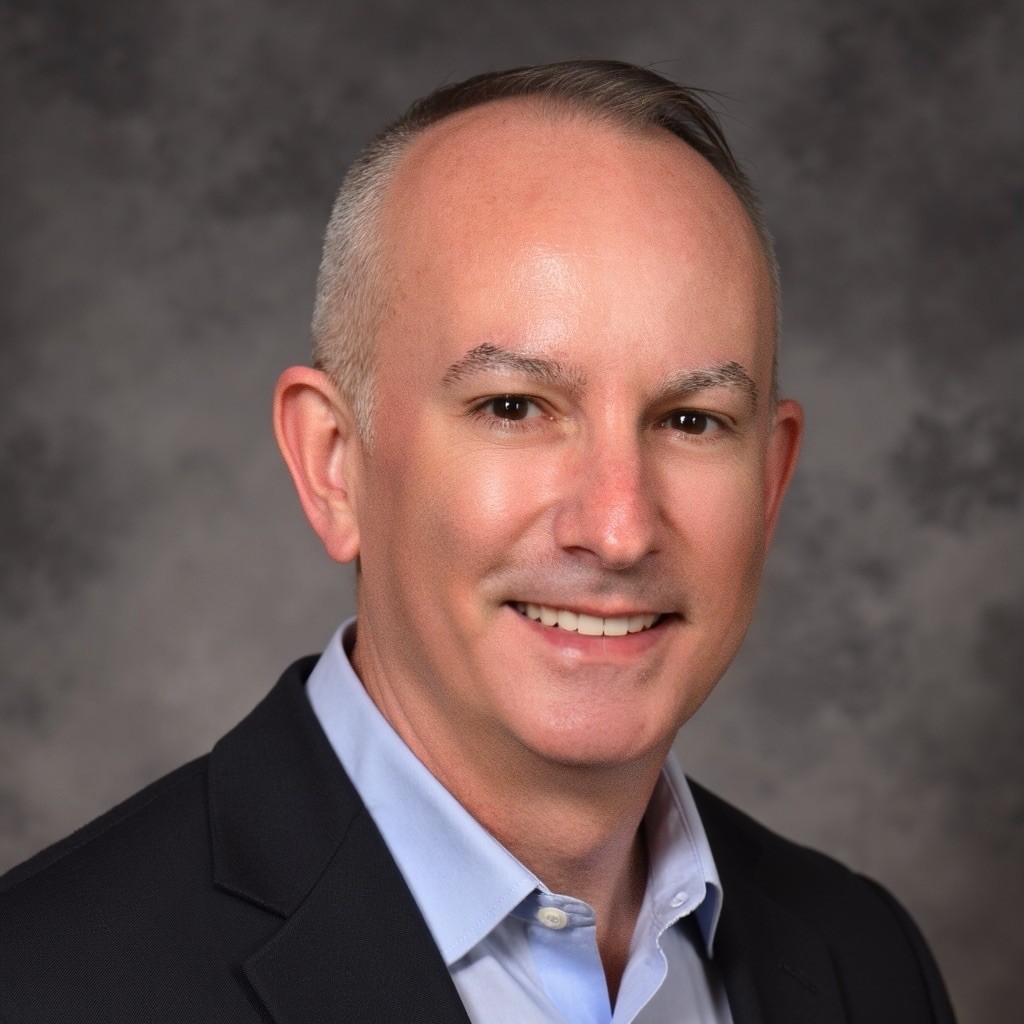
Shawn Galloway, CEO of ProAct Safety, is an expert in safety excellence. With almost thirty years of experience, he is a highly sought-after advisor, keynote speaker, and expert witness. Shawn has become a trusted partner to leading organizations across various industries worldwide. He ranks in the top 1% of the most prolific writers in his field, having authored over 500 articles and several bestselling books. He also launched the world's first safety podcast, Safety Culture Excellence©. As a recognized authority in safety, Shawn has received awards such as being named among the Top 50 People Who Most Influence EHS and a Top 10 Speaker, among others.
He is a regular guest on Bloomberg, Fox News, The Daily Mail, Dubai One, U.S. News & World Report, Sirius Business Radio, Wharton Business Daily, and leading safety magazines and podcasts. Shawn also serves as a member of the Harvard Business Review Advisory Council, Forbes Business Council, and Fast Company Executive Board, enabling his influence to shape safety thinking and strategy at the executive level.
